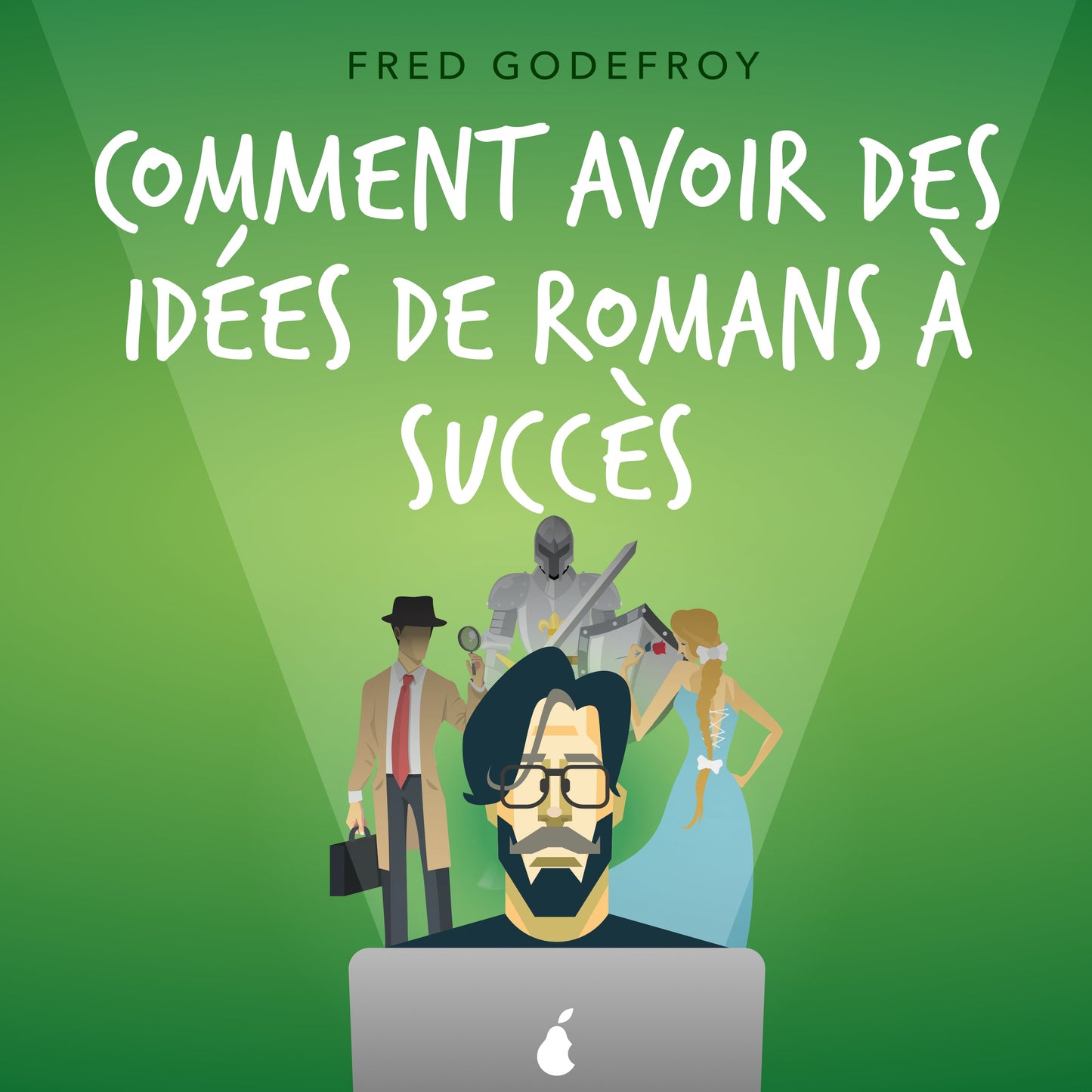

How to come up with ideas for successful novels
How to come up with ideas for successful novels
from Fred Godfrey
Read by Jérôme Carrette
Duration: 3 hours and 5 minutes
Format: M4B audiobook and MP3 files in a zip file
Couldn't load pickup availability
Boost your creativity and the power of your ideas to write novels your readers won't be able to put down.
A novelist has to be an idea-generating machine. There's no way around it! But where do good ideas come from, and how do you improve them to write a successful novel?
Do you have an idea for a novel?
Okay, but is one idea enough to write a 25,000, 50,000, or 120,000-word novel? No! You need dozens and dozens. And even if you have a good idea for your entire novel, you can still improve it into a great idea that will carry your whole writing.
If you sit down at your desk with just one idea for your novel, you might manage to write 15,000 or 20,000 words. But then that manuscript will end up in a drawer, the graveyard of unfinished novels. Professional writers can't spend hours or days writing novels they don't finish.
In this book, a sequel to *How to Write Bestselling Novels*, Fred Godefroy explores your raw material: ideas. Everyday ideas, once-in-a-lifetime ideas, ideas that come to you spontaneously, but above all, ideas that you observe, jot down, and develop. These novel ideas are what make the difference between an unfinished novel and a bestseller.
“Creativity is not a talent. It’s a way of operating.” – John Cleese
And you can master this method to overcome writer's block. Because you need dozens and dozens of good ideas for a novel: some will be decent, some will be rubbish, and others will have the potential to be further improved to write a successful novel.
This book also focuses on the Idea, the Big Idea, the one that will carry you through the end of the novel, through the slower parts of the middle, but also through each stage of the heroic structure. With this book, you will learn concretely how to prepare the super-concept for your novels, series, and sagas.
"You have ideas all the time. The only difference between writers and other people is that people notice when they're doing it." - Neil Gaiman